Open Data Wizard
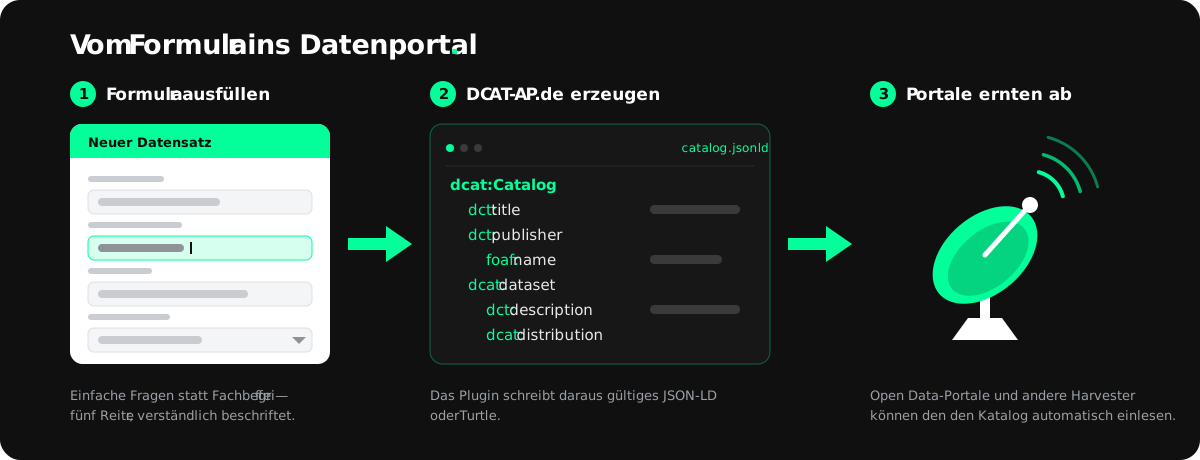
The Open Data Wizard turns a WordPress site into a source that open data portals can harvest automatically. You describe your datasets in the familiar back end, and the plugin generates a machine-readable description following the European standard.
Purpose
Publishing data rarely fails for lack of willingness. It fails because of the extra effort, and because it is not clear what exactly needs doing. This applies particularly to metadata. Catalogues require entries following DCAT-AP, with field names such as dct:publisher or dcatde:politicalGeocodingLevelURI. Anyone who does not work with these daily is guessing.
The usual route runs through someone else’s portal: register there, enter there, maintain there. The organisation gives up control and ties itself to infrastructure it does not own. The wizard reverses the direction: the catalogue is created at your end, and the portal collects it.
Use
An assistant guides you through the entries in five steps. It works with questions instead of technical terms: “Who is publishing this data?” stands in place of dct:publisher. The technical labels are still there, in an expandable help text, and anyone who knows them will find them.
Themes, formats, languages and licences come from the official vocabularies. You select “Environment”, and the corresponding URI is stored. Drafts can be saved incomplete; completeness is only required on publication, and missing fields are named in plain language. For larger holdings there is an import from CSV or JSON.
At the end your catalogue sits at a permanent address. Portals add it and collect the metadata themselves at regular intervals. Only the description travels to the portal, never the file. The same entries can be delivered to any number of portals without being maintained more than once.
A quality assessment following EU methodology shows which entry is missing for a dataset to become easier to find. The output passes the official validation rules of GovData and the EU. Those rule files are included, so you can check for yourself before registering with a portal.
Limits
The plugin is not a data portal. It has no search interface for third parties; instead, it makes a single organisation harvestable.
Nor does it manage any files. Those stay where they are: in the media library, on a server, in a repository. The plugin only describes them.
And it is no substitute for professional care. It checks whether a licence has been given, not whether it is the right one. It reports missing fields, not weak descriptions. What the description says remains your work.
Origin
Running a portal of your own for a handful of datasets is out of all proportion. Yet most organisations that want to publish are in exactly this situation: three or five datasets, no IT department, but an existing website. This is where the plugin comes in, and the effort stays where the work already happens.
The plugin needs WordPress 6.4 and PHP 8.1 or later. The source code is public on GitHub, under GPL-3.0. The interface is in German and fully translated into English.